
A Garden for Meditation
The Calm at the Heart of ChangeOriginally, Sukhavati Garden was conceived as a landscaping project for the natural area behind the Institute, creating a quiet outdoor space conducive to meditation practice.
Following the construction of the Great Stupa, which enshrines the relics of Künzig Shamarpa, the addition of eight gilded copper stupas, a large prayer wheel, and two commemorative stupas dedicated to Lama Gendun Rinpoche and Lama Purtse has naturally shaped new spaces within the garden.
The circumambulation path linking all of Dhagpo’s stupas extended the garden to the surroundings of Dhagpo’s historic temple.
Today, the garden is expanding once again to offer a new meditation space. A pathway will lead directly to the heart of the Institute’s Residences garden, which will be home to a new stupa and meditative spaces.
The Eight Stupas
In the tradition of Tibetan Buddhism, there are eight specific forms that commemorate important moments in the life of Buddha Shakyamuni. One finds a specific form of stupa for each event marking the Buddha’s life, from his birth to his death, including his attainment of enlightenment. The amount of elements involved and the manner of assembly vary from one type to another.
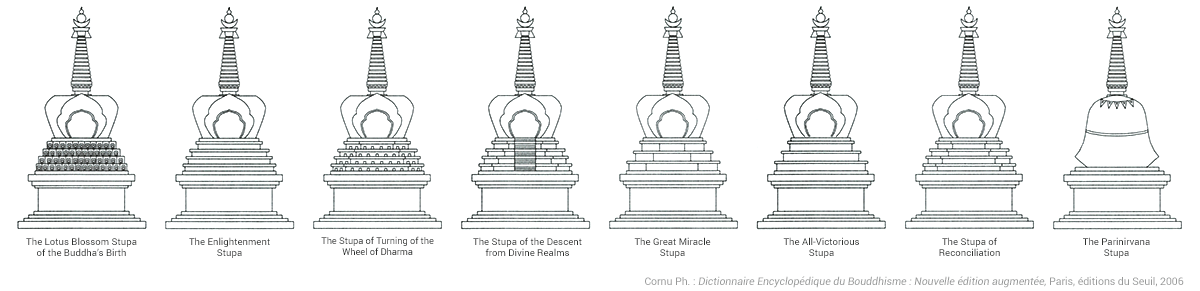
- The Lotus Blossom Stupa celebrates the Buddha’s birth in Lumbini park.
- The Conquest of Mara or Enlightenment Stupa commemorates his enlightenment in Bodhgaya.
- The Stupa of Turning the Wheel of Dharma recalls his first teaching following enlightenment in Sarnath’s Deer Park.
- The Stupa of Descent from Tushita Heaven celebrates his return among humans on Mount Sankashya following a stay in the divine realms where the Buddha went to give teachings to his mother.
- The Reconciliation Stupa recalls the end of the schism at Rajgir.
- 6. The Great Miracle Stupa commemorates how the Buddha overcame mistaken masters of philosophy in Shravasti.
- The All-Victorious Stupa celebrates victory over death at Vaishali.
- The Parinirvana Stupa recalls the Buddha’s death in Kushinagar.
The eight stupas are fabricated in copper finished with gold leaf, according to tradition. They were created by Gérard Guinot, an artisan in connection with Dhagpo who is also responsible for the statues of the Institute and the small temple. Each stupa will be roughly 1.7 meters (5 ft., 7 in.) high. They will be placed on granite blocks in pairs. A pavilion-style roof will protect them from the elements.
The Prayer Wheels
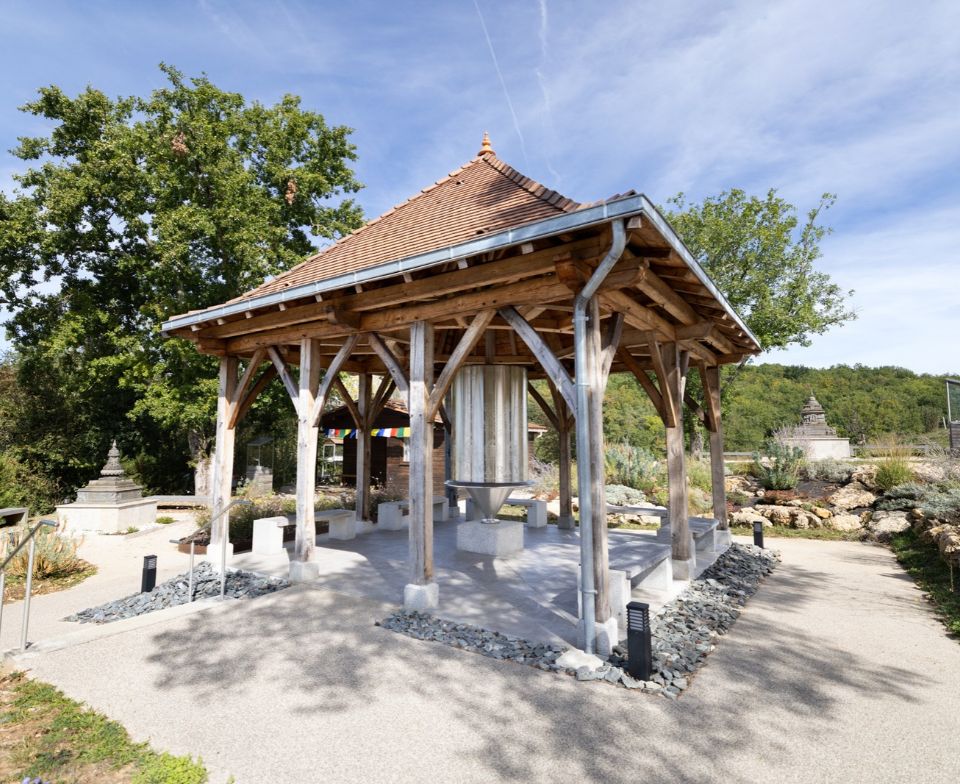
In an open pavilion overhanging Shamar Rinpoche’s stupa and the eight stupas, there will be a manual prayer wheel engraved with Kalachakra’s mantra.
There will be a sitting area available for meditation, turning the prayer wheel, or contemplation close by Lama Purtsela’s house.
The Two Carved Stone Stupas
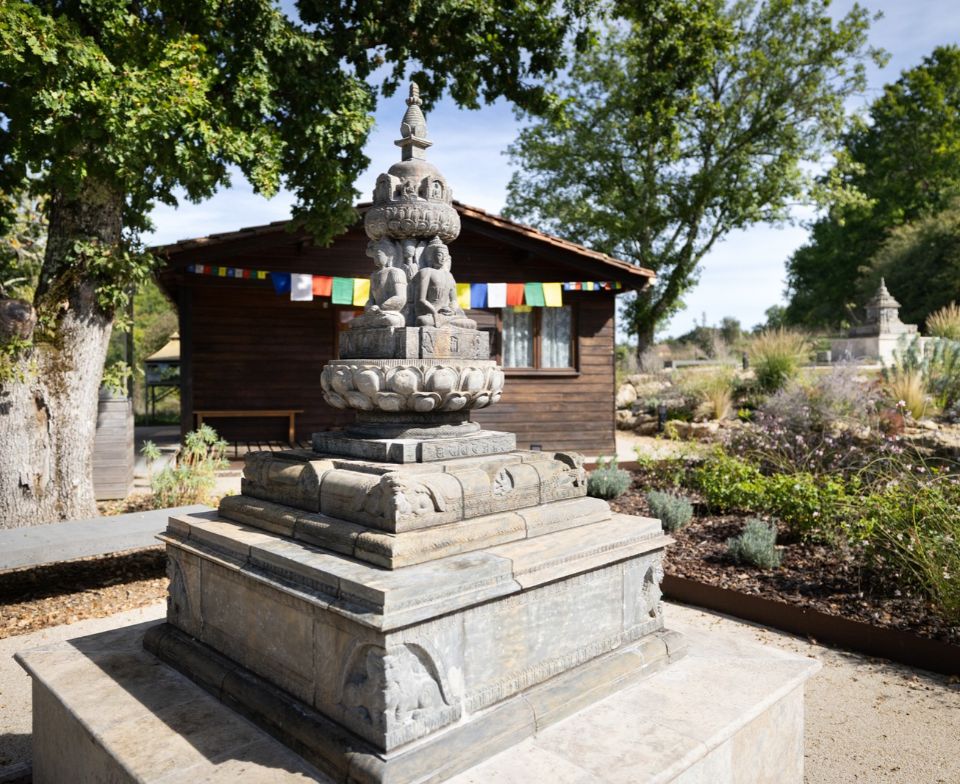
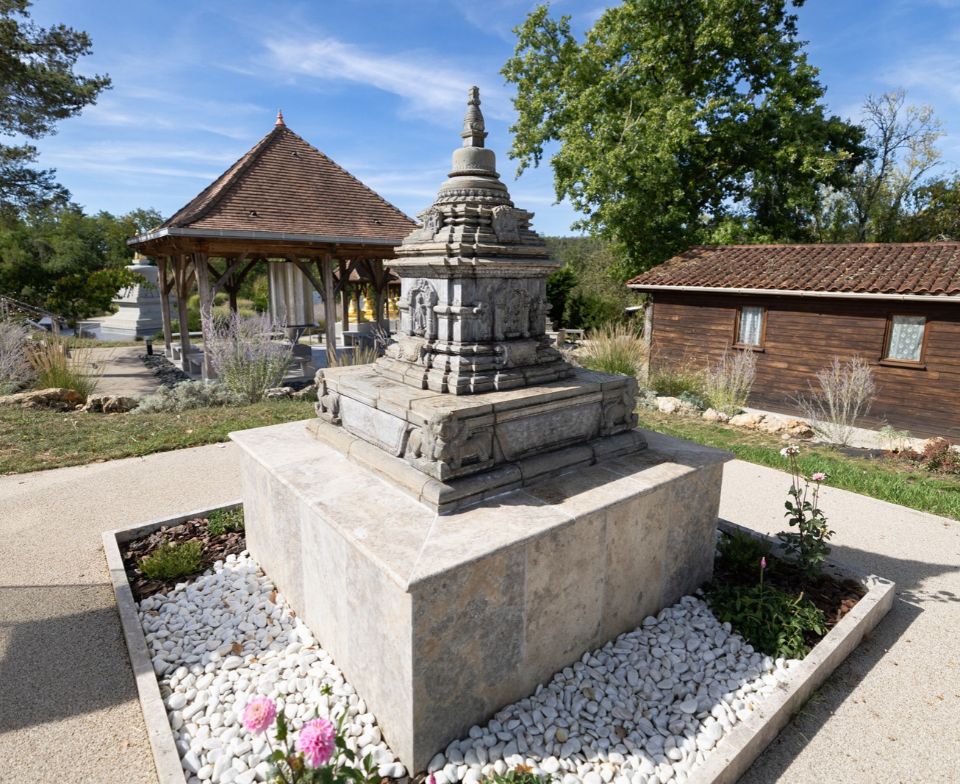
These two stupas were crafted in the traditional Nepalese style. They were carved in Nepal, then assembled and consecrated at Dhagpo. Their presence is an homage to Lama Gendun Rinpoche and Lama Purtsela.
The Circumambulation Path
A circumambulation path links all of Dhagpo’s stupas. Beginning at the Stupa of Enlightenment in front of the Institute, it continues to Shamar Rinpoche’s Stupa and the Eight Stupas, then passes the two carved stone stupas, the prayer wheel pavilion, and the prayer flags before reaching the historic stupa. From there, it continues past the prayer wheels and the surroundings of the historic temple before returning to the forecourt of the Institute.
The Licchavi Chaitya Stupa
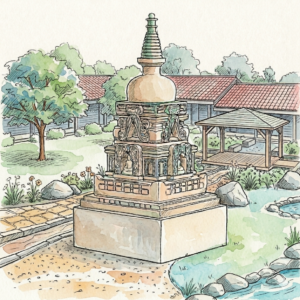
Composed of a square base surmounted by a dome and crowned with a finial, this Nepalese-style carved stone stupa will echo the two existing stone stupas while being larger in scale.
 Notes from the Road
Follow the progress of the project…
Beginning the Renovation of the Temple’s Surroundings
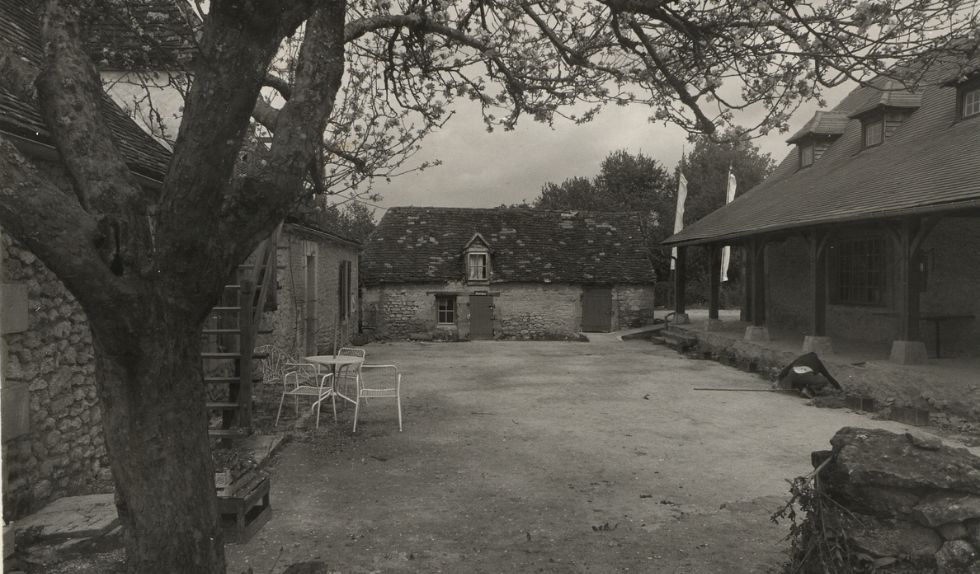
Work on renovating the surroundings of Dhagpo’s historic temple began with restoring the facade of the Lama House. Indeed, the joints between the stones had become practically nonexistent. After deep cleaning the stones, volunteer artisans sandblasted the facades...
The Renovation of Dhagpo’s Historic Stupa
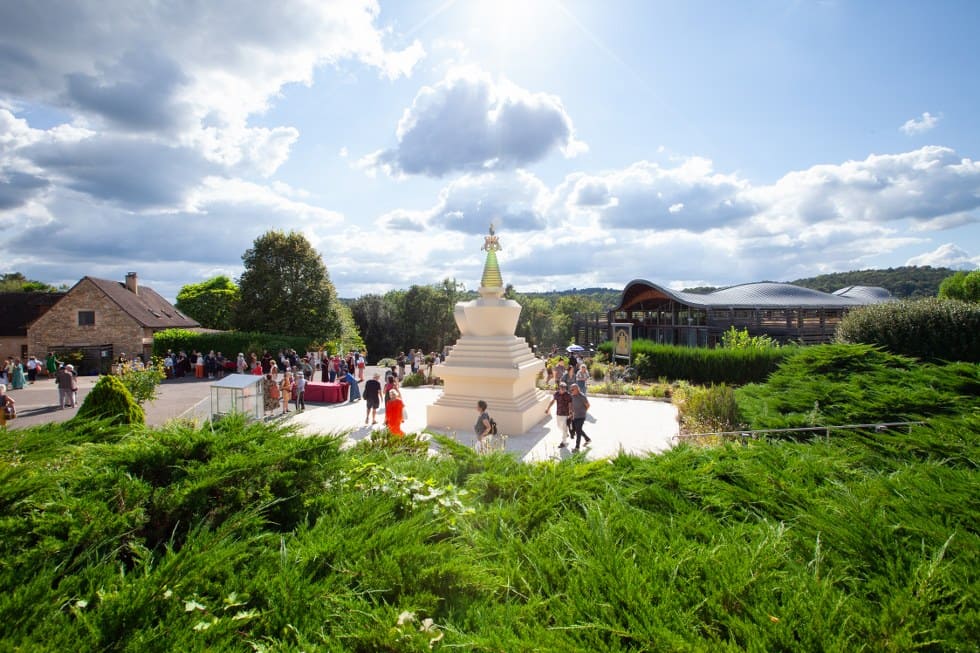
The stupa of enlightenment is Dhagpo’s historical stupa, built in 1992. This stupa is a witness to all of the steps of Dhagpo’s development: visits from Thaye Dorje, the 17th Gyalwa Karmapa and Mipham Chökyi Lodrö, the 14th Kunzig Shamar Rinpoche as well as those...
The Final Consecration of Sukhavati Garden by Karmapa
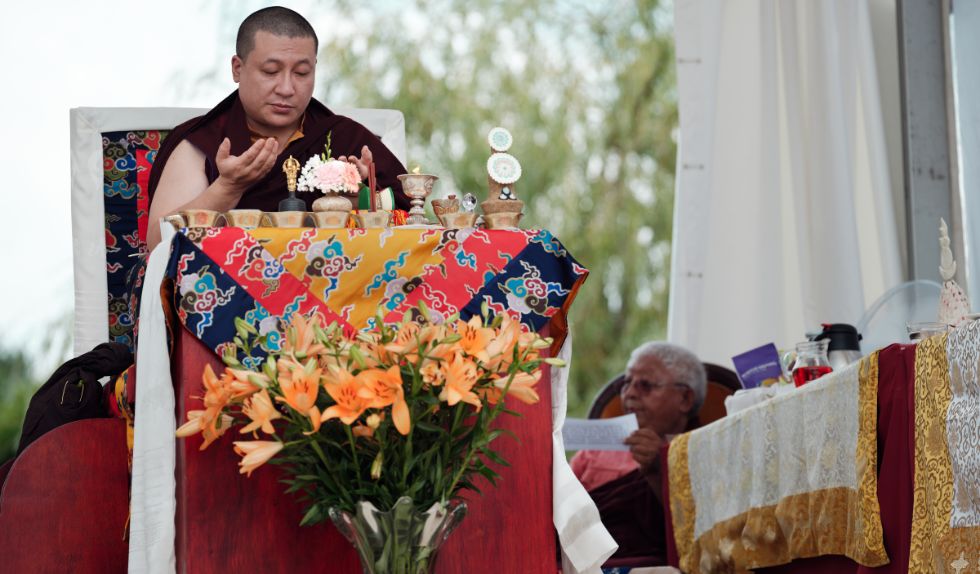
While Sukhavati Garden was still being built, Lama Jigme Rinpoche expressed the wish that Thaye Dorje, His Holiness the 17th Gyalwa Karmapa, carry out the final consecration. Jigme Rinpoche has explained on numerous occasions that the blessing of the Karmapas and...


